Most of The Office's fans probably already know that the popular American zitcom is actually a remake of a British comedy. In this hillarious digital short from Saturday Night Live, the creator of the original British version, Ricky Gervais, explains how he was inspired by a Japanese TV show.
Translation:
***************************************************
Pam: Hello. Dunder Mifflin. This is Pam.
Micheal: Pamo Pamo Pamo Pamoooooooo-san.
Pam: Micheal. What is it?
Micheal: Just being original.
(Bows)
Micheal: I am the funniest boss in Japan. (Coffee cup reads: Funniest boss in the world).
Jim: (calling Dwight) Where's the stapler?
Dwight: (Finding the stapler in a blob of Jello) Fool!
Micheal: What's going on?
Dwight, Jim, Pam: (Bowing to Micheal) Please excuse me. Please excuse me. Please excuse me. Please, excuse me.
(Princess Tampon commercial)
Micheal: I am the regional manager.
Dwight: I am the assistant regional manager.
Micheal: The regional manager's assistant! Why are you up here? Ok! Let's exercise!
Pam: Everyone really loves when Micheal messes up!
Micheal: Well, it was a good day. We did a good job. What do you think (to the bobble head)? Yes, yes, yes!
(Karaoke)
Dwight: Cheers!
(Produced by Souya Sara and Souya Hana)
Minggu, 18 Mei 2008
SNL: Japanese Version of The Office (with Translation)

Sabtu, 08 Maret 2008
Sharin No Uta : English Translation : Bump of Chicken
Sharin No Uta : The Wheel Song
The rusty wheels make a shriek
Carrying our bodies to the station at dawn
As I peddle
The thing you transmit as you lean against my back
Is definite warmth
Up the hill along the train tracks
“A little more, just a bit further”
From behind your voice sounds like you’re having fun
The town is way too quiet
“It’s like we’re the only people in the world” you grumble softly
At the moment we reached the top of the hill
We were at a loss for words
The sunrise that welcomed us was way too beautiful
Then I think you laughed behind me
I couldn’t look back because I was crying
I don’t really know the town
The most expensive ticket on
First end of the ticket machine goes to
The cheapest of all, the platform ticket
Even though I’d use it immediately
I carefully put it away
The big bag you bought
The day before yesterday
Caught on the wicket and,
Unable to pass through, you looked at me
I nodded without meeting your eyes
And my hand freed the bag’s stubbornly caught cord
The resounding bell announces the end
The door opens only for you
Having stepped forward,
One step with more distance than many thousands, you say
"I promise! We’ll definitely meet again some day!"
Unable to answer, with my eyes cast down, I waved my hand
You... You weren't wrong that time...
Down the hill along the train tracks,I fly
Faster than the wind
I catch up with you and
The rusty wheel shrieks
With all my might, I line up with the train but
It slowly gets further away
You were crying, weren’t you
On the other side of the door
Even though I didn’t see your face,
I knew because your voice was shaking
I promise. We’ll definitely meet again someday
As you got further away,
I made a big wave with my hand so that you could see
The town was bustling but
“It’s like I’m the only person in the world” I grumbled softly
The rusty wheels shriek
Left behind, I’m carried along
A faint warmth
Senin, 11 Februari 2008
Supernova : English Translation : Bump of Chicken
Supernova: Bump of Chicken
Translation by Melissa Chasse ©
When I get a fever I realize
That I have a body
When my nose gets stuffy I realize
That I’ve been breathing all this time
You’re existence
I make sure of it so many times but
You know how truly precious someone is
Once they’re gone
When I refused your outstretched hand
There might have been a big earthquake
When I protected your outstretched hand
The one I wanted to protect may have been myself
You’re existence
I always held on to it so tightly but
I’m really afraid so
I just can’t let go
La la la…
Talking to people I realize
There’s nothing I want to say
When I try to put the words together
I understand I’m full of feelings I want to express
Your existence
I can keep talking about it like this but
true gratitude
Can’t be expressed by a mere “thank you”
La la la…
In our clock (In the time we have)
We want
to grasp just one truth
and pass it on…
When I try to count the years, I realize
However slight, I had a history
At almost the same time I understand
An end will come to that, too
I can remember you whenever I want but
What I really want is
Not memories, it’s the present
It's after I forget you that I remember
I had a history with you
It's after I loose you that I discover
I met you by chance
A person’s existence
In this world is worthless, but
Somebody’s world
Can be built on it
Your existence
I confirm it so many times, but
Your true existence is that
Even when you’re gone, you’re here
Our clock doesn’t stop
It’s moving
La la la…
Kamis, 31 Januari 2008
Pooping on Gion : Geisha Beware!
Japan's wealthy playboys and camera-toting tourists are not the only ones drawn to the soft, red glow of Gion's paper lanters. Kyoto's most famous hanamachi, or geisha entertainment district, is also the preferred hangout of murders of young crows!
(Narrator): "Gion is crowded with people, but they're all worried about what's overhead..."
(Geisha Customer): "I was just saying, right? (maiko: Yes, you were.) You have to be careful with good kimono.
Geisha: That's right.
(Maiko in green, Yukako): "It's nasty, isin't it! Lately its always falling right before my eyes. I can't stand it!
(Narrator): Just then...
It's raining poop! An innocent bystander is splatter with white bird droppings!
(Maiko): Oh no! You went out (from under the covered walkway).
(Geisha): I was suprised! Onii-san (big brother),the timing! Poor thing!
(Poor thing): It doesn't come out!
(Geiko): But it's dangerous over there, too. There are so many (birds) up there.
(Narrator): And again... (Another poop bomb splatters the pavement).
Blah, blah, blah... I just thought that first bit was hilarious! Especially since I have seen people fall victim to the occasional poop bomb, although I myslef have yet to be targeted. (^_^)x <--- That's me keeping my fingers crossed.
Kamis, 17 Januari 2008
Kurama Fire Festival : 鞍馬の火祭り

Nestled high in northern Kyoto's mountains, the rural town of Kurama consists of traditional, tiled-roof homes and shops crowded along a single main road, narrowly winding its way through the evergreen mountaintops that rise on either side. Each year, on October 22, as the moon begins to rise over these steely blue ridges and night casts its sleepy shadow over the usually quite town, a river of visitors from all over Japan flows from the small, provincial train station, flooding the town in a buzz of anticipation and excitement as they prepare to witness the rites and rituals of Kurama's famous Fire Festival. The Kyoto Shimbun Newspaper numbered the festival-goers in 2008 at over 10,200!


Today the sacred Shinto rituals begin at 6 pm, but visitors begin arriving long before, seeking out the best places to experience the event and vying to get as close to the action as possible. By the time the sun disappears behind the hills, all open areas along the main road are filled with space-impaired spectators, corralled behind ropes and barriers to keep them a safe distance from the madness that will eventually ensue. Late-comers are ushered behind the early bird crowds by a seemingly infinite number of policemen, politely prodded to keep moving on a continual circuit from the train station, through the town, and back again, past homes and shops with torches of all sizes displayed proudly outside.


A high school students shoulders the tail end of a 5 meter torch as sparks rain down behind him. Catching one of these falling sparks on your skin is said to be very auspicious, if not painful.
 These enormous torches weigh over 100 kilos, or 220 pounds.
 A group of scantily clad young men show off their "cute hips" in the revealing traditional festival gear.


The omikoshi and I with my new friends.


 Any Japanese festival is a great place to make new friends!
Senin, 31 Desember 2007
Nengajo: Japanese New Year's Cards

A brilliant up and coming graphic designer in Tokyo, Yuki Nakano designed this nengajo to welcome 2008: The Year of the Rat. The design of most nengajo includes the junishi, or Oriental zodiac animal, of the New Year.
Oshogatsu, or New Year's, is a very special time in Japan—a time for people return to their ancestral homes, spend time with their families and get in touch with their roots. Perhaps the most honored and celebrated of the Japanese holidays, Oshogatsu is a three-day event beginning with Omisoka (New Year's Eve) and lasting through the first three days of the year. Many people wear traditional clothing, like kimono, and play traditional games, such as uta garuta. Preparations begin long in advance as people clean their homes from top to bottom (known as Osouji), prepare Osechi ryori (traditional New Year's food eaten during the forst three days of the new year), and write nengajo, or New Year's greetings.
These days, many people use designs including photos of themselves or their families on their nengajo.
Much like the Christmas cards exchanged in the US and abroad, nengajo are an important part of Japan's New Year's festivities. Now an established tradition, the exchange of these New Year's greetings began in 1873, when postcards were first introduced to Japan. Today, the average family sends over a hundred nengajo to family, friends and colleagues, and businesses mail them to all their customers.
New Year's is a time for wafuku (traditional Japanese clothing) and Osechi ryori, traditional Japanese New Year's food.

Of course, if you are a card-carrying gaijin, you are theoretically exempt from all of these rules. Why not surprise your friends and colleagues with your astounding nengajo knowledge and skill? The same gracious people that praise your ability to use chopsticks and poor attempts at speaking Japanese will be thrilled with the thoughtful consideration and effort, regardless of when your nengajo arrives.

Hand drawn by one of my students, this was the first nengajo I recieved in Japan.

Happy New Year, everyone! ☆明けましておめでとう☆
Senin, 10 Desember 2007
Kojima Yoshio : English Teacher!
Comedian Yoshio Kojima trys his hand at teaching English...
**************************
Woman: (Hoping for help from Kojima, she reads him her homework)
Kojima: Wow, you're horrible! That's not even close!
Woman: It's been so long since I read English...
Kids: Well then, you read it!
Kojima: Shall I read it for you? That's not smooth at all, and there's so much space between the words foreigners will never understand you!
Woman: Well then, Mr. Kojima, if you would, please...
Kojima: (Brilliant English-- no translation needed!)
Woman: What language is that?
Kojima: It's English!!!
♪♪♪ Acutally I can't read English、but that doesn't matter! ♪♪♪
Hai, OPPAPI!
*(Note: Oppapi supposedly stands for "Ocean Pacific Peace". Does that explanation sounds dubious to anyone else?)
...And Japanese!
Kojima attempts to help a young boy learn a kanji, or Chinese character...
Koijima: This is the character "naku", "to cry," Ok?
Boy: Naku (to cry).
Kojima: Naku. To Cry. This is easy. Umm... (baby cries) will you be quiet? Uh... first, WHOA! Don't pull my undies down, OK?! That's dangerous!
(Begins to draw) This is a crying... Do you got it? It's a crying person. Crying. He is crying. Crying. Cryin'. Cry crai cra crr cr... CRYING!
(Kojima shows the progression of the kanji from picture to pictograph)
Boy: I still don't quite understand...
Kojima: You still don't understand? Ok, but this is how I got into Waseda...
Wow. When you explain kanji like that, it really starts to make sense! I bet naku is one kanji that boy will never forget.
Much thanks to Japan Probe for always bringing the best of Japanese TV to the blogsphere, and for being a much cooler blog than this will ever be. m(- -)m
Selasa, 20 November 2007
"Hana No Na" English Translation: 花の名 : Bump of Chicken
If it is such a simple thing, I wonder why can't I say it?
Even if I forget the sky we saw together,
If you are a flower,
From them, I chose one
My being here is proof that you were here
Since I borrowed the power to live,
When you forget the tears and the smiles,
Everyone has a person they want to see
Always
If you are a flower,
Someday
Selasa, 10 April 2007
Okoshiyasu!
 Naosuzu (geiko) and Katsue(maiko)welcome a customer to the an outdoor tea ceremony beneath the cherry blossoms in Kyoto. Okoshiyasu is Kyoto dialect for welcome.
Jumat, 02 Februari 2007
"Oni Wa Soto! Fuku Wa Uchi!"

The Long-Nosed Goblin of Mt. Atago: Performed by the geiko of Gion Higashi. During setsubun, many people hang Okame masks (thought to bring good luck), like the one above.
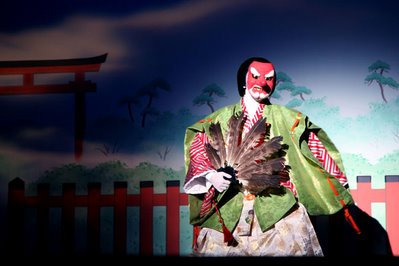 A long-nose oni (goblin, devil) mask.
As in China, the celebrations were not without their hideously evil creatures. The devilish Oni were originally invisible spirits or gods which caused disasters, disease, and other general unpleasantness in the lives of humans, taking on a variety of forms to deceive (and often devour) them. The Chinese character (鬼) meaning "ghost" came to be used for these formless creatures. It was not until Buddhism arrived that Oni took on its present ogre-like form.
I'm off to Kyoto to experience mamemaki myself! Happy Setsubun! Fuyu was soto! Haru was Uchi! (Out with winter! In with Spring!)
Rabu, 31 Januari 2007
Shakai no Mado: Your Social Window
 Transalation: Shakai no mado: Social window, society's window.
 Welcome to the ever-interesting world of Japanese idiomatic expressions. I don't care how good your Japanese is, I'm betting this is something only living in Japan can teach you-until now. I doubt they covered it in Japan-go 101, but hey, I could be wrong. Here goes:
Allow me to set the scene. An innocent, enthusiastuc ALT, (AKA, Me) doing her best to be genki (energetic and entertaining) despite the fact that the temperature inside the school is zero and the teachers have decided that, since so many students have been catching colds, they should start keeping the doors and windows open (What the $#$%@%@Q@#%# ?!) As she jumps, dances, and karate-chops her way around the room, pretending to play "Simon Says" in a crude attempt to survive the bitter cold...
Student: Sensei?
Teacher: Yes?
Student: Society's window.
Teacher: Huh? (clueless).
Student: Social Window! (Trying to be discreet).
Teacher: WHAT the heck is that? Social window? What does that mean? (loud and obnoxious. If everyone wasn't listening before, they are now).
Student: It's open.
Sensei: . . . Oh...
So, what does it mean?
Senin, 18 Desember 2006
Gion Odori 2006: Acts Two and Three

Act Two: Okome. Okome is the Japanese word for rice (before it is cooked). The geiko Mariko, dancing as a Shinto priestess for a plentiful harvest of rice in early spring. In January, maiko wear a stalk of rice in their hair to celebrate the new year.
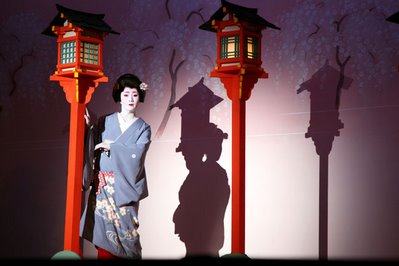
Act Three: Shidarezakura. Shidare zakura (from sakura), or weeping cherry. Before the famous weeping cherries of Maruyama Koen, near Yasaka Shrine, an elder geiko awaits her true love until she is discovered by her younger sister .
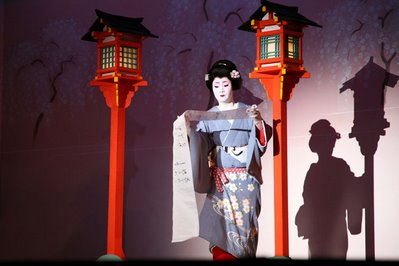 Uh oh! She recollectin' ya'll! Reading an unusually long rabureta (love letter) in the absence of her beloved.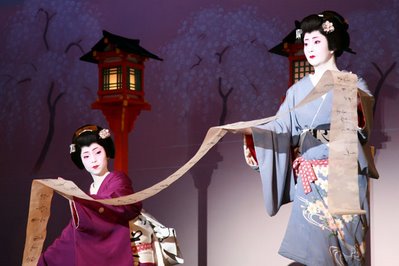
I know that correspondence is often recommended to encourage affection, but this is ridiculous sis!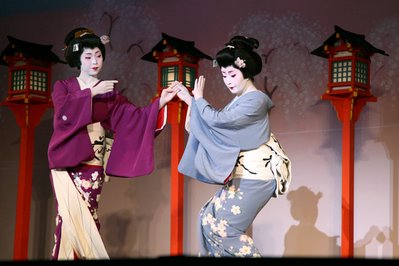
Don't make me...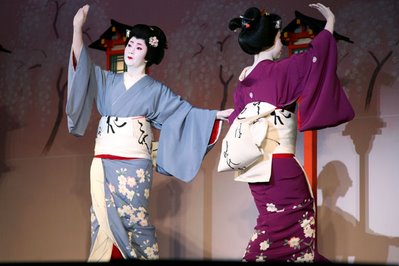 I love the beautiful bend of their hands, so limber and graceful. It reminds me of the Apsara dance of Cambodia...
Sabtu, 16 Desember 2006
Gion Odori 2006: Maneki
 Masayo and Miharu.
The theme of this year's Gion Odori, the fall dance performed by the maiko and geiko of Gion Higashi, was "Seasonal Glories of the Maiko's Hanakanzashi," or flowered hair ornaments.
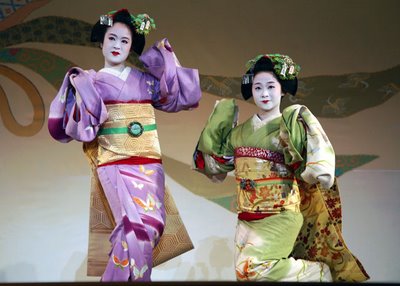 Masayo and Fumiki.
In December, maiko wear the maneki hanakanzashi. This dance depicted the maiko attending the year-end debut of Kabuki actors at the Minamiza theater. A young maiko overcomes her shyness to ask her favorite actor for his signature "with her big courage".
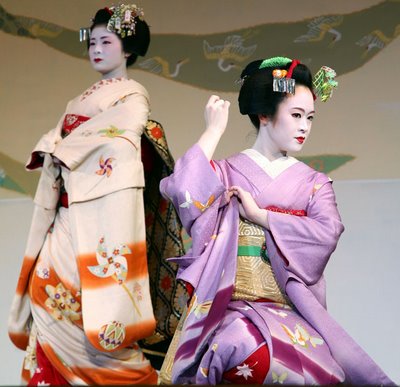
Masayo, the highest ranking maiko in Gion Higashi, dancing during the opening act of this year's Gion Odori: Maneki. This years theme was hanakanzashi, the flowered hair ornaments worn by the maiko. Each dance reflected the meaning and seasons in which each hanakanzashi is worn.

During Kaomise (from about Nov.30- Dec. 26) , the names of the performing Kabuki actors are written on long, wooden boards called maneki kanban, and hung outside the theater. Maiko attend the Kaomise (face showing) Kabuki performances, wearing these Maneki hanakanzashi. Two small, blank tags are attatched, and maiko ask their favorite Kabuki actors to sign them afterwards.
Fukimi and Miharu strike a Maneki Neko, or beckoning cat, pose.
Fumiki and Umeha.


Selasa, 14 November 2006
Misoekai: Miyagawa's Fall Dance

Kimitomo 君友 peeks out demurely from behind her gold-speckled fan. The extravagant silks, colorful kimonos, flowery hair ornaments and hauntingly beautiful make up are only part of a maiko's beauty, and impressive as they are, the true allure lies in her child-like innocence.


As a geiko, Kimina 君奈 no longer relies on the flashy kimonos or ornate hair ornaments. She has attained a level of skill that speaks for itself with every graceful movement.


Harumi 春美

Kikuryuu 菊柳 perfroming a traditional dance in which awamochi vendors take turns pounding rice cakes as they perform various acts. Awamochi is a type of rice cake that was popular during the Edo Era and is still made today.

Minggu, 12 November 2006
Pretty in Pink: Miyofuku

As I stood talking to the old women of Sakuraya, I noticed this young maiko walk past and call at an okiya down the street. After some time had passed, I noticed that she had not yet slipped behind the slit wooden grill of the sliding door, but stood nervously, looking up and down the street. I asked the Okaasan if she was ok, so we walked down to find out. Poor Miyofuku had been locked out of her okiya, and with everyone at rehersals for the fall dance recitals, she didn't know where to go or what do to. Finally Yasuha and Fukuyoshi came by and took her home with them.
Man, I don't know why she didnt just kick off those clogs and climb in through a window! That's what i always used to do when I got locked out (^_<) Hehehe....Just kidding.
Kamis, 03 Agustus 2006
The Flower Procession: Gion Matsuri
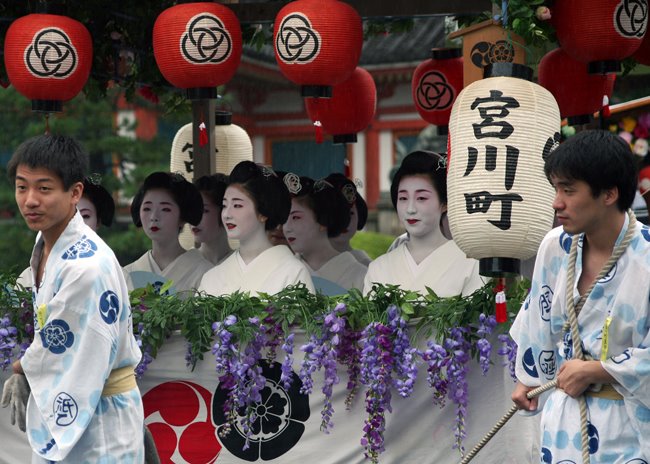 Maiko from Miyagawa-cho being pulled through Kyoto by young men from their neighborhood.
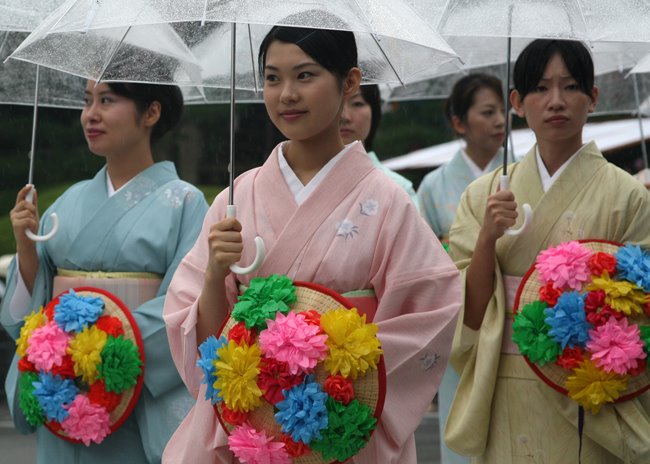 Young women carrying their hanagasa, straw hats covered with fake paper flowers, seek shelter beneath their umbrellas.
 Kanazuru, a maiko from Miyagawa-cho.
 A young White Herron Dancer giggling as she ran for cover from the relentless rain.
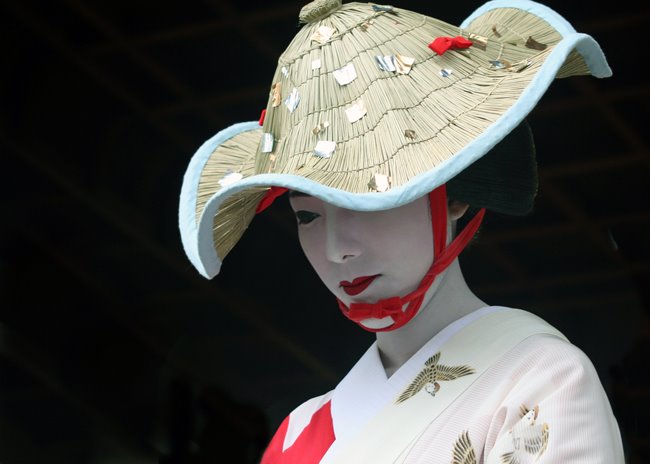 A maiko from Gion.
 A shrine maiden of Yasaka Jinja tries to keep her hanagasa in place.